


| Osum Canyons hydropower scandal (2017–2018) | |
|---|---|
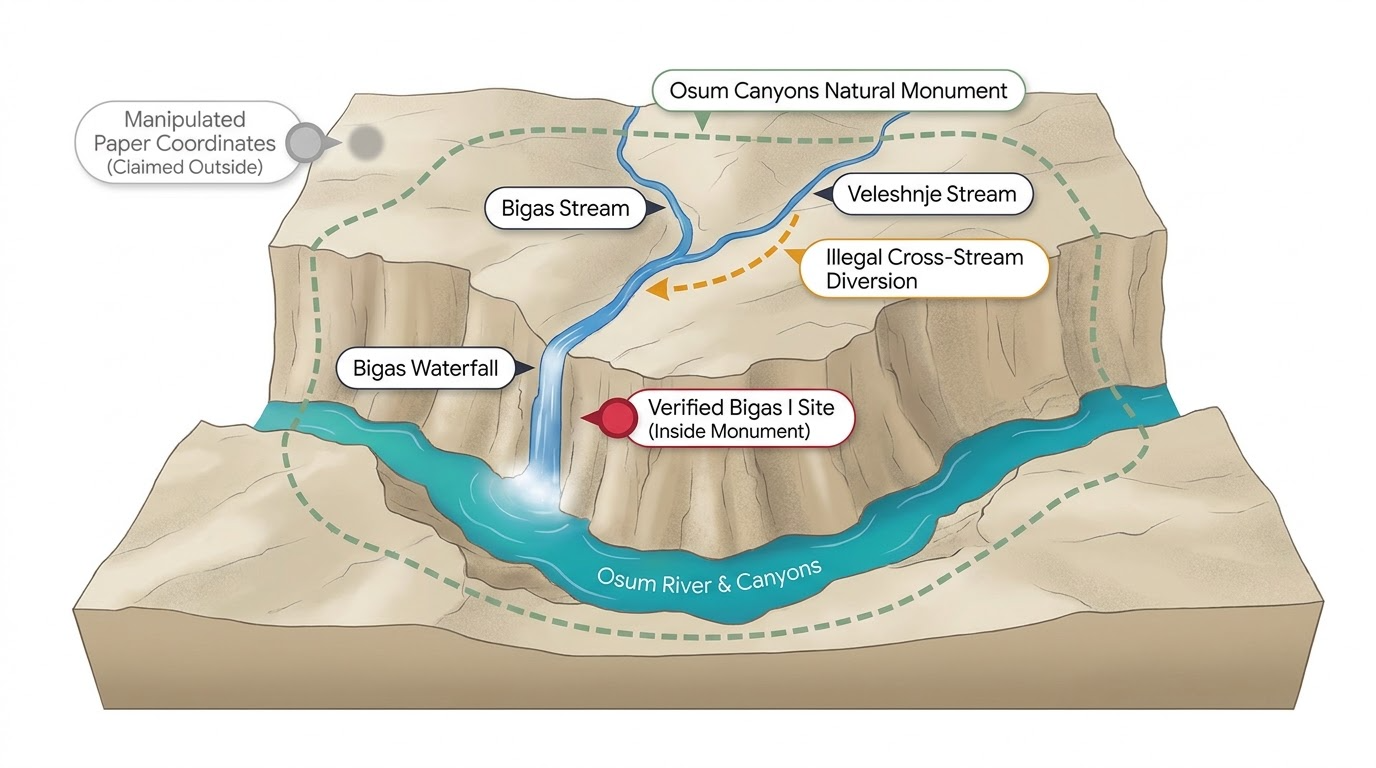 Spatial and hydrological discrepancies documented by AKZM and KLSH Audit No. 1086/1: paper coordinates vs. verified Bigas I location inside the Osum Canyons Natural Monument and cross-stream diversion. | |
| Also known as | Osumi Canyon hydroelectric permits controversy; Bigas 1, Bigas 2 & Veleshnje HPPs affair |
| Date | September 2013 – 2026 (core scandal Feb 2018; appellate rulings 2018–2019; Supreme Court docket 2026) |
| Location | Osum Canyons Natural Monument (Bigas & Veleshnje streams), Skrapar / Berat, Albania |
| Type | Administrative & environmental permitting controversy; manipulated spatial coordinates; expired EIA; civil society litigation |
| Estimated value / cost | Planned capacity 0.5 MW (2013) expanded to 1.2 MW (May 2016); 600–900 kW in regional registries |
| Key participants |
|
| Institutions involved |
|
| Investigating bodies |
|
| Legal status / outcome | Audit / administrative findings EIA declared invalid (15 Feb 2018); unilateral termination initiated (19 Feb 2018); cancellation upheld by First Instance Administrative Court (30 Jul 2018) & Administrative Court of Appeal (7 Mar 2019). Zero criminal indictments or convictions of senior officials; lingering administrative litigation on Supreme Court docket (31001-00320-00-2026) in 2026. |
The Osum Canyons hydropower scandal (Albanian: Skandali i HEC-eve në Kanionet e Osumit) was a 2017–2018 administrative, environmental, and political controversy in Albania surrounding permitting for three small hydropower plants (HPPs)—Bigas 1, Bigas 2, and Veleshnje—along tributaries feeding the Osum Canyons Natural Monument in Skrapar.[1][2] Originally awarded as a 0.5 MW concession on 6 September 2013 at the close of Sali Berisha's government and expanded to 1.2 MW by Edi Rama's Ministry of Energy and Industry on 16 May 2016, the project triggered a national crisis in February 2018 when investigative reporting revealed that the National Territory Council (KKT), chaired by Prime Minister Rama, had secretly approved a development permit on 12 December 2017 despite an expired environmental impact assessment (EIA), manipulated spatial coordinates, and formal written warnings sent nine months earlier by then-Speaker of Parliament Ilir Meta.[1][2][3]
Following public outcry from local communities, rafting operators, and environmental groups, the Rama government executed a ten-day executive rollback in February 2018—suspending construction, declaring the 2015 preliminary EIA absolutely invalid, and initiating unilateral termination of the concession held by HP Bigas dhe Veleshnje Energy sh.p.k.[4][5] When the concessionaire challenged the cancellation in administrative court, the First Instance Administrative Court of Tirana (30 July 2018) and the Administrative Court of Appeal (7 March 2019) upheld the revocation—outcomes shaped decisively by the courtroom intervention of civil society groups EcoAlbania and the Albanian Rafting Federation—while an audit by the Supreme State Audit (KLSH) (Audit No. 1086/1) documented contradictory spatial certifications across state agencies.[6][7][8] Despite executive pledges of criminal referrals, no criminal indictments or convictions of senior government officials resulted, leaving the affair an administrative and environmental milestone with lingering appellate litigation reaching the Supreme Court of Albania docket in 2026.[9][10][11]
Background and concession expansion (2013–2016)
Designated a Natural Monument in 2002, the Osum Canyons feature 70-to-100-meter limestone walls carved over two to three million years and eight waterfalls—including the Bigas cascade—that have anchored Albania's first commercial whitewater rafting operations since 2004.[12][8] Under Law No. 81/2017 (On Protected Areas), industrial hydropower construction inside a designated Natural Monument is legally prohibited.[7]
Despite those ecological sensitivities, the outgoing government of Prime Minister Sali Berisha approved a concession contract on 6 September 2013—at the end of its mandate—to construct three small HPPs (Bigas 1, Bigas 2, and Veleshnje) on streams feeding into the Osum gorge in Skrapar.[2] Three weeks later, on 27 September 2013, the special-purpose vehicle HP Bigas dhe Veleshnje Energy sh.p.k. (NIPT L39604401K) was registered in Berat as a wholly owned subsidiary of 2 AF sh.p.k. (reported by BIRN as solely owned by Erfan Feta and managed by administrator Alban (Albano) Feta).[2][13]
On 26 March 2015, the National Environment Agency (AKM) under the Ministry of Environment—then led by Lefter Koka—issued Preliminary EIA Decision No. 13 (ID No. 137) approving Bigas 1 and Bigas 2.[3][14] Crucially, Clause 8.2 of that decision stipulated that the environmental clearance would automatically become invalid if construction did not begin within two years (by 26 March 2017).[3] Although Edi Rama's Socialist government had pledged upon taking office to cancel late-term Berisha-era concessions, on 16 May 2016 the Ministry of Energy and Industry—led by Damian Gjiknuri—instead amended the concession contract, merging Bigas 1 and Bigas 2 and more than doubling planned installed capacity from 0.5 MW to 1.2 MW.[1] (Regional hydropower registries and Berat municipal energy plans separately cataloged Bigas 1 and Bigas 2 between 600 kW and 900 kW combined.)[2][15]
Warning letters, secret permit approval, and February 2018 rollback
What transformed the concession into a national political controversy in early 2018 was documentary proof that senior cabinet leaders had been formally warned prior to signing the final development permit:
- 9 March 2017 warning letter: Then-Speaker of the Parliament of Albania Ilir Meta sent an official letter titled "Shqetësime ndaj projektit mbi lumin Osum" ("Concerns regarding the project on the Osum River") to Environment Minister Lefter Koka, formally copied to Prime Minister Edi Rama and Energy Minister Damian Gjiknuri.[2] Relaying complaints from rafting operators, environmentalists, and Berat residents, Meta's letter warned that the plants would destroy the Bigas waterfalls and canyon ecosystem and flagged specific legal omissions—including the exclusion of connecting parcel 36 from the KKT permit and the absence of a water use permit for HEC Veleshnje.[2]
- 26 March 2017 EIA expiration: Seventeen days after Meta's letter, Preliminary EIA Decision No. 13/ID 137 legally expired under Clause 8.2 because construction had not started.[3]
- 12 December 2017 unpublished KKT permit: Nearly nine months after both the warning letter and the EIA's statutory expiry, the National Territory Council (KKT)—chaired by Prime Minister Rama—approved the development permit for the Bigas and Veleshnje HPPs without publishing the decision.[2]
- 8 January 2018 internal memo: Newly appointed Tourism and Environment Minister Blendi Klosi sent a formal memorandum to Infrastructure and Energy Minister Damian Gjiknuri flagging flaws in the concession and requesting its cancellation.[3]
In early February 2018, the arrival of heavy machinery near Veleshnje prompted investigative reports by Gazeta TemA (7 February) and Top Channel (8 February), exposing both the alleged coordinate manipulation and the expired 2015 EIA.[16][3] On 9 February 2018, Rama published a Facebook statement ("Kanionet e Skraparit nuk preken" — "The Skrapar Canyons are not touched") attributing the episode to a residual Berisha-era permit and an uncovered "criminal fabrication with manipulated coordinates"; that same day, BIRN published the facsimile of Meta's March 2017 warning letter.[2][4] Between 9 and 19 February 2018, the executive executed a three-step rollback:
- 9 February 2018: Environmental authorities (MTM / ISHMPU) issued Official Notice No. 638, ordering the immediate suspension of construction and operational works.[14]
- 15 February 2018: The Ministry of Tourism and Environment issued Decision No. 1, declaring Preliminary EIA Decision No. 13 (ID No. 137) absolutely invalid due to false data regarding water extraction volumes and geographical coordinates.[4][14]
- 19 February 2018: The Ministry of Infrastructure and Energy formally notified the concessionaire that it had initiated unilateral contract termination procedures under Article 12 of the concession agreement.[4][5]
Document manipulation and regulatory failures
On-site technical verifications led by National Agency of Protected Areas (AKZM) Director Zamir Dedej, MTM's administrative review, and KLSH Audit No. 1086/1 (17 September 2018) documented systemic breakdowns across the permitting chain:[2][7]
| Violation / Failure | Technical or Legal Finding | Reviewing Institution(s) | Documentary & Legal Consequence |
|---|---|---|---|
| Manipulated coordinates & monument overlap | Coordinates in the 2015 EIA did not match actual construction sites; detailed site layouts confirmed Bigas I sat inside the Osum Canyons Natural Monument.[2][7] | Ministry of Environment (Koka era), AKM, AKZM, KLSH Audit No. 1086/1 | Violated Law No. 81/2017 (On Protected Areas); triggered AKZM's formal opposition on 8 May 2018.[7] |
| Illegal cross-stream water diversion | Engineering plans diverted water from the Veleshnje stream and placed its turbines and discharge into the separate Bigas stream.[2] | AKZM on-site technical verification (Zamir Dedej) | Breached environmental rules requiring hydropower water to return to the same river body.[2] |
| Faulty elevation metrics (kuota) | Development permit relied on elevation quotes (kuota) rather than strict geographical coordinates, with intake and discharge elevations nearly identical.[2] | KKT / AKZM technical review | Rendered hydroelectric generation functionally unworkable on paper, evidencing defective technical scrutiny.[2] |
| Inaccurate water volume data | Preliminary EIA contained false or inaccurate projections regarding water extracted from the Bigas watershed.[1][4] | MTM / AKM | Cited alongside coordinate errors as core grounds for MTM Decision No. 1 invalidating the 2015 EIA.[4] |
| Expired environmental permit | Preliminary EIA Decision No. 13 (ID No. 137) carried Clause 8.2 invalidating the clearance if works did not start within two years (26 March 2017).[3] | AKM (issuer); KKT (approved Dec 2017 permit despite expiry) | Rendered the 12 December 2017 KKT development permit legally untenable without a new EIA.[2][3] |
| Missing land & water authorizations | KKT permit omitted connecting parcel 36, and HEC Veleshnje lacked a valid water use permit.[2] | Flagged in Ilir Meta's 9 March 2017 letter | Showed substantive legal defects reached top executive leadership nine months prior to KKT approval.[2] |
| Contradictory AKZM certifications | AKZM initially certified the project lay outside Protected Areas based solely on applicant-supplied coordinates, then reversed itself on 8 May 2018 upon inspecting technical site plans.[7] | KLSH Audit No. 1086/1 (17 September 2018) | Demonstrated that agencies relied on applicant coordinates rather than independent on-site layout verification.[7] |
Court battles and civil society intervention (2018–2026)
Main article: Osum Canyons hydropower administrative litigation
In spring 2018, HP Bigas dhe Veleshnje Energy sh.p.k. filed an administrative lawsuit against MTM, MIE, AKM, ISHMPU, and the State Advocacy (Avokatura e Shtetit), arguing that the state had endorsed the project in 2015, failed to serve an on-site inspection report (procesverbal), and violated the Principle of Legal Certainty (Parimi i Sigurisë Juridike).[1][14] After presiding Judge Afërdita Maho denied a stay on 18 April 2018, EcoAlbania (led by Executive Director Olsi Nika) and the Albanian Rafting Federation (led by Zamo Spathara and co-founder Blerina Ago), represented by the Law Clinic of Durrës (supported by OSFA), intervened as secondary parties (ndërhyrës dytësorë).[1][14][8] According to Nika, MIE had abandoned early courtroom defense, making civil society's intervention decisive.[8]
On 30 July 2018, Judge Maho dismissed the lawsuit in full as "unfounded in evidence and law", ruling that state environmental agencies acted within their statutory mandates to protect the primary public interest (interesi publik).[14][6] After the company re-applied on 26 December 2018 with the same documentation and filed a second suit—and AKZM rejected the application while expanding the protected zone—the Administrative Court of Appeal upheld cancellation of all three HPPs on 7 March 2019.[8] Nonetheless, parallel or lingering administrative appeals by the concessionaire against MTM, AKM, and AKZM continued into November 2025 at the Administrative Court of Appeal and appeared on the Supreme Court of Albania administrative deliberation chamber docket in 2026 under Case No. 31001-00320-00-2026 (with full merits and final outcome unavailable in public registry extracts).[17][18][11] No public records indicate that the concessionaire ever initiated international investment arbitration.[19]
Absence of criminal indictments and broader policy context
Although Prime Minister Rama pledged on 9 February 2018 that "the individuals involved in this fabrication will be reported to the prosecutor's office" and Minister Klosi announced planned criminal referrals (kallëzim penal) against everyone who signed off on the manipulated coordinates, no documented criminal indictment, prosecution, or conviction of senior ministers or agency directors occurred.[2][9][10] Analysts and comparative legal scholarship attribute this non-penal outcome to three structural factors: (1) the First Instance Administrative Court focused strictly on administrative legality without issuing judicial criminal referrals;[6] (2) Albania lacked robust environmental criminal-law pathways capable of converting protected-area permitting disputes into penal prosecutions;[20] and (3) institutional responsibility was diffused across two administrations and four agencies between 2013 and 2017.[2][7]
At the policy level, the Osum dispute unfolded alongside three other landmark 2016–2018 HPP lawsuits (Vjosa/Poçem, Valbona, and Seta) amid an estimated pipeline of roughly 500 hydropower plants across Albania—105 of them inside protected areas.[20] It also highlighted a sharp economic asymmetry: sacrificing a premier adventure-tourism canyon and its eight waterfalls for a 0.6–1.2 MW run-of-river project whose long-term viability faced projected UNFCCC national rainfall declines of roughly 14.37% by 2080 and over 18% by 2100.[8][20] On 23 February 2018, Rama publicly pledged "no HPP where tourism is harmed", though environmental advocates such as EcoAlbania's Olsi Nika cautioned that isolated cancellations did not eliminate broader permitting pressures in protected ecosystems.[19][8]
See also
Notes
- Some contemporaneous February 2018 press accounts misprinted the date of MTM Decision No. 1 revoking the 2015 preliminary EIA as 15 February 2017; official Ministry of Infrastructure and Energy releases and the July 2018 Tirana Administrative Court record establish Decision No. 1 as dated 15 February 2018.
References
- ↑ a b c d e f BIRN "HEC-et në kanionet e Osumit; koncesionari sfidon kryeministrin në gjykatë" . BIRN Albania / Reporter.al. 2018-04-25 .
- ↑ a b c d e f g h i j k l m n o p q r s t u BIRN "Rama u paralajmërua nga Meta, por i firmosi HEC-et në Osum në dijeni të shkeljeve" . BIRN Albania / Reporter.al. 2018-02-09 .
- ↑ a b c d e f g h Press "Ekskluzive / Leja mjedisore e HEC-eve mbi kanionet e Osumit, e skaduar" . Top Channel. 2018-02-08 (AKM Decision No. 13 / ID No. 137 (26.03.2015), Clause 8.2; MTM Memo (08.01.2018)) .
- ↑ a b c d e f BIRN "Fillimi i fundit për kontratën e HEC-eve në lumin Osum" . BIRN Albania / Reporter.al. 2018-02-19 .
- ↑ a b Official Record "HEC-et në Osum, MIE nis procedurat për zgjidhjen e kontratës" . Ministry of Infrastructure and Energy (MIE). 2018-02-19 (Article 12 Concession Contract Termination Notice (19.02.2018)) .
- ↑ a b c BIRN "Gjykata Administrative vulos anulimin e HEC-eve në kanionet e Osumit" . BIRN Albania / Reporter.al. 2018-07-31 .
- ↑ a b c d e f g h i Press "HEC-et, "peshqeshi" për zonat e mbrojtura, banorët humbën ujin dhe turizmin" . Albanian Center for Quality Journalism (ACQJ) & Amfora.al. 2018 (KLSH Audit No. 1086/1 (17.09.2018)) .
- ↑ a b c d e f g Press "Shoqëria civile nis betejën në gjykata për projektet mjedisore" . Porta Vendore. 2019-04-26 .
- ↑ a b Press "HPPs in the Osumi Canyons, Rama reacts for the first time" . BalkanWeb. 2018-02 .
- ↑ a b Press "HEC-et në Osum, Klosi: Do bëjmë kallëzim penal për të gjithë ata që firmosën" . JavaNews. 2018-02 .
- ↑ a b Court "Për shqyrtim në dhomë këshillimi - Administrative (Çështja Nr. 31001-00320-00-2026)" . Gjykata e Lartë e Republikës së Shqipërisë (Supreme Court of Albania). 2026 (Case No. 31001-00320-00-2026) .
- ↑Press "The Balkan Rivers Tour arrives at the Osumi River" . BalkanWeb. 2018 .
- ↑Official Record "HP Bigas dhe Veleshnje ENERGY (NIPT L39604401K)" . OpenCorporates Albania / QKB. 2024-04-11 (QKB NIPT L39604401K) .
- ↑ a b c d e f Press "Gjykata rrëzon HEC-et mbi Kanionet e Osumit" . Gazeta TemA. 2018-07-31 (MTM Decision No. 1 (15.02.2018); AKM Decision No. 13/ID 137 (26.03.2015); Notice No. 638 (09.02.2018)) .
- ↑Official Record "Municipal Energy and Climate Action Plan (MECAP) of Berat" . Bashkia Berat. 2024-04-09 .
- ↑Press "FAKSIMILE: Thellohet skandali, Ministria e Mjedisit manipuloi koordinatat për ndërtimin e HEC-eve në Osum" . Gazeta TemA. 2018-02-07 .
- ↑Press "Koncesionarët "mësyjnë" gjykatën, markimi i karburanteve, HEC-et mbi Osum kundër institucioneve" . Monitor.al. 2019-03-19 .
- ↑Court "Shpallur më 21.10.2025 — Gjykata Administrative e Apelit" . Gjykata Administrative e Apelit (Administrative Court of Appeal). 2025-10-21 .
- ↑ a b Press "Rama zotohet: Asnjë HEC aty ku cenohet turizmi" . Top Channel. 2018-02-23 .
- ↑ a b c Press "Learning Loops in the Public Realm: Transposition of Advocacy Experience as Triple-Loop Social Learning in Albania: Fighting HPPs in Protected Areas from the Vjosa River Basin to the Canyons of Osumi" . ResearchGate (Academic Study). 2019 .
Revision history
- 2026-11-23 — Initial encyclopedic dossier authored from the Osum Canyons intake dossier, BIRN Albania (Reporter.al) investigations, ACQJ/Amfora KLSH Audit No. 1086/1 coverage, Top Channel and Gazeta TemA document facsimiles, Porta Vendore, and Administrative/Supreme Court dockets.